Cover To Cover is the anchor program for GPB’s literary coverage. Cover To Cover features a collection of distinctive Southern voices interviewing Georgia writers, Southern writers, and writers dealing with the South. The GPB Southern Lit Cadre will provide you with a varied, weekly glimpse at fiction, non-fiction, history, poetry, and even the occasional ‘old school’ nod to Flannery O’Connor or William Faulkner.


Friday, October 31, 2008

Cover To Cover, What's The Word Step Aside Sunday For Live Coverage of U.S. Senate Debate


Cover To Cover
and What's The Word will not air Sunday night, November 2 at 8pm so that GPB Radio listeners can hear the live Atlanta Press Club-U.S. Senate Debate between Saxby Chambliss and Jim Martin. Both shows will return next week. Cover To Cover will feature Jesse Freeman's interview with Tony Grooms with a look back at his revelatory collection of short stories, Trouble No More.

Friday, October 24, 2008

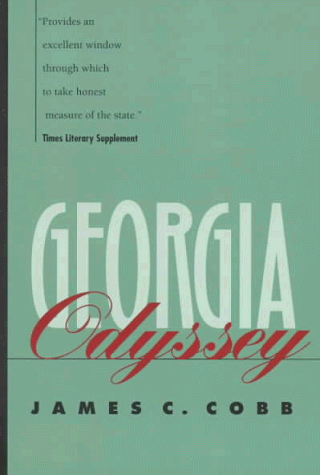
Georgia Odyssey


Jeff Calder interviews imminent UGA Historian James Cobb about his book Georgia Odyssey this week on Cover to Cover.

The reader will put the book down with a deeper understanding of Georgia in all its contradictions.... "Odyssey" is no dry academic history...[i]nstead, it's an engagingly written volume that sometimes reads more like an irreverent conversation than words on paper.
--Lee Shearer, Athens Banner-Herald


Cover to Cover airs Sunday at 8Pm on Georgia Public Broadcasting.

Friday, October 10, 2008

Ronda Rich Talks With Celia Rivenbark About Belle Weather Sunday on Cover To Cover


Sunday at 8pm on GPB Radio, Ronda Rich interviews Celia Rivenbark about her latest book
Belle Weather: Mostly Sunny With a Chance of Scattered Hissy Fits. Rivenbark is an award-winning newspaper columnist and freelance journalist whose work has been compared to a cross between Erma Bombeck and Hunter S. Thompson. Celia has won national and state press awards and is the author of four humor collections: Bless Your Heart, Tramp (2000, reprinted in 2006), We're Just Like You, Only Prettier (2004), and Stop Dressing Your Six-Year-Old Like a Skank (2006). Her latest book is filled with a compendium of provocative essays, including:
--The joys of remodeling Tara
--How Harry Potter bitch-slaps Nancy Drew
--Britney’s To-Do list: pick okra, cover that thang up
--How rugby-playing lesbians torpedoed beach day
--Why French women suck at competitive eating
--The truth about nature deficit disorder
--The difference between cockroaches and water bugs
--The beauty of Bedazzlers
And much, much more!
Join Dixie Diva Ronda Rich as she has a Southern Culture hen party with Celia Rivenbark Sunday, October 12 at 8pm on GPB's Cover To Cover.

Friday, October 3, 2008

Bob Schieffer's America


If you're looking for evidence of bias in the media, you'll have to look further than Bob Schieffer. The longtime host of CBS' "Face the Nation" talked to us while in Atlanta promoting his new book,Bob Schieffer's America and was the very embodiment of the impartial observer virtually all journalists claim to be.
As in his book, in our Cover to Cover interview, the veteran newsman in our interview was as folksy as he was informative as we covered a wide range of issues both historical and contemporary, including media bias. Through it all, and in Bob Schieffer's America, the legendary broadcaster was careful to avoid partisanship, expressing his personal thoughts but never in a way to provide fodder for conservatives or liberals. Schieffer shared his insights on the many presidents he has covered (every one since Nixon) and acknowledged that the current financial crisis is the most challenging story he has ever had to report on, owing to its complex nature. In the midst of this crisis--and an historic presidential election (Schieffer will moderate the final debate between John McCain and Barack Obama)--Schieffer's interview provides a tremendous opportunity to hear the thoughts of one of the most clear-headed voices anywhere on some of the most crucial issues that face our nation.
-Frank Reiss


Frank's interview with Bob Schieffer airs this Sunday at 8PM on GPB's Cover to Cover.

Friday, September 26, 2008

The Olympics That Changed the World


This week on Cover to Cover, Frank Reiss interviews David Maraniss about Maraniss's latest book Rome 1960. Here's a quick rundown from their conversation:

At the recently-ended Summer Olympics in China, the haul of gold medals by Michael Phelps, the otherworldly speed of the Jamaican sprinters and the fierce competition between American and Chinese gymnasts filled the airwaves for two solid weeks. As did talk of political propaganda, accusations of rule-breaking and other controversies large and small.

While it seems that the Olympics have forever been dominated in such a way, bestselling author David Maraniss argues in his most recent book, Rome, 1960: The Olympics That Changed the World, that it was at these particular summer games that the Olympics as we now know them first came into being.

That was the year when the world first became familiar with a clownish fighter from Louisville, Kentucky named Cassius Clay, who used the games as a springboard to become the most famous athlete the world has ever known: Muhammad Ali. But Maraniss goes to some lengths to restore Clay's proper place at the time: a definite second or third banana to the true heroes of that year, African-American track stars Wilma Rudolph and Rafer Johnson.

1960 was also the first Olympics for which an American television network purchased broadcast rights, and an unknown reporter named Jim McKay, working under the most primitive conditions imaginable, debuted in the role that made him as familiar as any Olympic performer.

And the Cold War politics of the day foreshadowed the political propaganda that continues to be inescapable in this quadrennial event that supposedly transcends politics.

But to Marannis--who has won the Pulitzer Prize and authored a string of bestsellers about both sports and politics--these political overtones and social developments don't detract from the games, they give them historical context and make for a fascinating read and a stimulating conversation.

Marannis' writing is unmistakably influenced by his friend and long-time mentor, the late David Halberstam. Interestingly, though, Marannis contrasts his attitude toward sportswriting and historical/political writing. Halberstam, Maraniss says in his Cover to Cover interview, wrote about sports to relax between his more "serious" books. Marannis on the other hand thinks sports can be every bit as significant as politics, and politics can be as trivial as sports. -Frank Reiss

Catch Frank Reiss's interview with David Maraniss Sunday night at 8:00PM, rebroadcast Thursday night at 11:30p on GPB Radio. You can also listen to Cover To Cover on demand at gpb.org/covertocover.

Thursday, September 18, 2008

Tony Earley on Cover to Cover


Jesse Freeman weighs on in his interview with Tony Earley, which airs Sunday night at 8pm on Cover To Cover--

The Blue Star
is a sequel you can enjoy without having read its predecessor. However, if you consider yourself a lover of great contemporary fiction, you’ve probably already read Jim the Boy. Book two in this presumed trilogy places Jim in his senior year of high school in the Western North Carolina town of Aliceville. More to the point, it places our wide-eyed protagonist on the precipice of love, war and tragedy.

Tony Earley joins us to talk about Jim and his other wonderful characters that bring to life the Greatest Generation. He talks about the importance of his influences (Wila Cather!) and his own experience as a child in Appalachia. You’ll find Tony as humble as the avuncular Glass brothers (Jim’s surrogate fathers) and as witty as Dennis Deane (Jim’s loose-lipped running partner). Tony approaches an interview thoughtfully and we think you’ll appreciate the contemplative way he looks back at his works just as you will enjoy the earnestness of the works themselves.

Friday, September 12, 2008

Jack Pendarvis Talks About Awesome


Jack Pendarvis left South Alabama about 15 years ago, settled in Atlanta, where he had a job for Turner Broadcasting, and where he wrote stories and received rejection notices for many years. A few years ago, he started having his often wacky stories accepted by such publications as McSweeney's, The Believer and The Oxford American. In short order, his work attracted the notice of the renowned author Barry Hannah, who was instrumental in Pendarvis' receiving the John Grisham Chair of Creative Writing at the University of Mississippi in Oxford, where Pendarvis now resides. Pendarvis is also a recipient of the prestigious Pushcart Prize, which honors the best work published by small presses.

Macadam Cage, a San Francisco literary publisher with a thing for Southern writers, has published two collections of Pendarvis' short fiction: The Mysteriouis Secret of the Valuable Treasure and Your Body is Changing. This summer, they published his first novel, Awesome, a bizarre, and somewhat grotesque, tale about a ridiculously self-absorbed giant named Awesome.

Pendarvis celebrated the novel's publication in his old hometown of Atlanta in mid-August, and the following morning sat down in the GPB studios with Cover to Cover's Frank Reiss. The giddiness from the previous evening had not yet subsided, and what ensued was a weaving, over-the-center-line conversation that threatened to roll off the side of the road and over an embankment at any moment. And, perhaps to the ears of some, did.

Which, appropriately enough, is a perfect introduction to the fiction of Jack Pendarvis.

-Frank Reiss
Frank's interview with Jack Pendarvis airs Sunday at 8pm, repeats Thursday at 11:30 and can be heard on demand at gpb.org/covertocover.