Cover To Cover is the anchor program for GPB’s literary coverage. Cover To Cover features a collection of distinctive Southern voices interviewing Georgia writers, Southern writers, and writers dealing with the South. The GPB Southern Lit Cadre will provide you with a varied, weekly glimpse at fiction, non-fiction, history, poetry, and even the occasional ‘old school’ nod to Flannery O’Connor or William Faulkner.


Showing posts with label Jeff Calder. Show all posts

Tuesday, January 26, 2010

America's Lost Musical Genius


In The Ballad of Blind Tom, Australian author Deirdre O’ Connell describes her subject as “The most famous black performer of the Civil War generation.” Was he a naive genius or a freak? Was he a gifted, original American composer or a mere mimic of the reigning piano styles of the day? O’Connell wades through 50 years of press clips and testimony searching for the answer to the question, “Who was Blind Tom?”

He was born a slave in Columbus, Georgia. Despite his autistic condition, he made his guardians piles of money, perhaps, by today’s standard, millions of dollars, of which he and his family saw almost none. It would be story of overpowering sadness had Blind Tom not been so full of life. He took great delight in playing piano up to 12 hours a day, never regarding it as work even in the midst of a staggering itinerary. (In 1999, the pianist John Davis recorded a selection of his songs, John Davis Plays Blind Tom.)

Full of wit and wild anecdote, The Ballad of Blind Tom has an astonishing cast of characters. It is Deirdre O’Connell’s first book, and she spent a good deal of time in Georgia conducting research. She has also made documentaries for the Jimi Hendrix Estate and the United Nations Environment Program and has worked in news at SBS Australia.

Listen to this episode

Monday, December 14, 2009

Hand Me My Travelin' Shoes


Michael Gray’s Hand Me My Travelin’ Shoes: In Search of Blind Willie McTell (Chicago Review Press) is an exhaustive reconstruction of McTell’s life and times. It will surely stand as the definitive work on the man Michael Gray calls “the greatest blues singer Georgia has ever produced” and “The finest 12-string guitarist of his generation, barnone.”

Beginning in the 1990s, Gray made several trips to Georgia searching for information about McTell. His interest endured years of frustration. (He was even rousted by security officials while trying to photograph the Milledgeville state hospital where McTell died.) Nonetheless, he finally assembled a family tree which includes over 100 of McTell’s relatives, beginning with the singer’s white great-grandfather who fought in the Civil War under Robert E. Lee.

Hand Me My Travelin’ Shoes is the portrait of a self-sufficient man who was blind from birth, a gifted black musician who moved freely about the American South during the mean years of segregation. When he died in Atlanta at the age of 56, McTell was just short of the early 1960s folk revival, which most certainly would have embraced him as a major figure. Despite this historical mischance, recognition for McTell would begin to grow within a months of his death. In 1983, Bob Dylan stepped forward to say, “Nobody can sing the blues like Blind Willie McTell.” McTell’s “Statesboro Blues” has become universally known as a Southern Rock anthem as played by the Allman Brothers. McTell was inducted into the Georgia Music Hall of Fame in 1990.

Michael Gray writes for the UK Guardian and many other publications. He’s the author of several books, including The Bob Dylan Encyclopedia and The Elvis Atlas: A Journey through Elvis Presley’s America.

Listen to this episode

Wednesday, August 5, 2009

Music and Mysticism


This Sunday, Cover to Cover presents a special hour-long show featuring poet and Rumi translator Coleman Barks. Barks, a recent inductee into the Georgia Writers Hall of Fame, is interviewed by Jeff Calder, and had this to say about his subject:

Coleman Barks is one of the most popular literary figures to emerge from the South in recent decades. In person, he is gentle and accommodating, not at all fearsome until he draws himself up to recite a poem. Then everything gets extra real in the manner of 800 BC. The great seductive power of his voice—fully evident in the interview this Sunday, August 9—seems to put the listener in touch with the time when language first began to express complex psychological states.

Coleman has achieved an international profile as an interpreter of Rumi; his many translations of the Sufi poet have sold over a half-million copies worldwide.
He has written a half-dozen books of his own poetry, selections of which have recently been published under the title Winter Sky by the University of Georgia Press. He runs Maypop Books, a publishing company based in Athens, Georgia. He’s taken part in two hour-long PBS specials with Bill Moyers.

Coleman has appeared on an astonishing variety of recordings, reciting his own poetry and Rumi’s against backgrounds of mandolins and oboes from the West, sitars and tablas from the East. 2008 marked the release of The Here and The Gone, his third collaboration with Tuatara, the world music combo featuring Peter Buck of R.E.M. A variety of these songs can be heard throughout this hour-long interview.

In 2006, Coleman Barks received an Honorary Doctorate in Persian Language and Literature from the University of Tehran. He taught at the University of Georgia for 30 years and has since retired as Professor Emeritus.


Listen to this episode

Friday, January 9, 2009

Gay And Lesbian History of Atlanta, Sunday at 8pm on Cover To Cover


Join us as GPB Southern Lit Cadre member Jeff Calder interviews Wesley Chenault and Stacy Braukman, who have written Gay and Lesbian Atlanta. The book grew out of a 2005 Atlanta History Center exhibit called "The Unspoken Past-Atlanta Lesbian and Gay History," which explored an alternative history of Atlanta that runs parallel to the city's rise as a regional center of industry, arts, and culture.

Calder's rollicking chat with Chenault and Braukman touches on things humorous and poignant, and a time when Atlanta then, as now, was a magnet for people from across the South who came to the city to live lives they couldn't often openly live in surrounding smaller communities. If you are a student of Southern and Atlanta history, this interview will give you a new perspective.

Friday, October 24, 2008

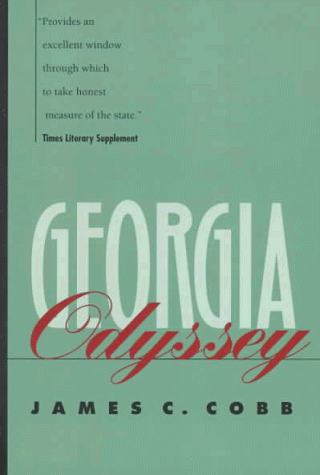
Georgia Odyssey


Jeff Calder interviews imminent UGA Historian James Cobb about his book Georgia Odyssey this week on Cover to Cover.

The reader will put the book down with a deeper understanding of Georgia in all its contradictions.... "Odyssey" is no dry academic history...[i]nstead, it's an engagingly written volume that sometimes reads more like an irreverent conversation than words on paper.
--Lee Shearer, Athens Banner-Herald


Cover to Cover airs Sunday at 8Pm on Georgia Public Broadcasting.

Thursday, September 4, 2008

Winners Have Yet to be Announced


This Sunday's Cover To Cover will be a "best of" issue. GPB Southern Lit Cadre Member Jeff Calder talks with University of Georgia Professor Ed Pavlic. Pavlic's new book is entitled Winners Have Yet To Be Announced: A Song For Donny Hathaway.

The book is Pavlic's attempt to see inside the life, music and untimely death of this elemental soul music artist, a man remembered for efforts as diverse as "Where Is The Love" with Roberta Flack or the theme to Norman Lear's 1970's sitcom "Maude." But Hathaway was highly influential in his own way, known as "your favorite soul singer's favorite singer." Pavlic tries to inhabit Hathaway, who left little in the way of legitimate biography or history after his jump from the 10th floor window of his room at the Essex House in New York City in 1979.

Writer and musician Jeff Calder and Pavlic talk about Hathaway, and Pavlic's approach to poetry. Listen in and you will also hear portions of Hathaway's songs "Give It Up" and "The Ghetto." We hope you enjoy this week's show. All comments, bouquets and brickbats to ask@gpb.org.